


AI Portfolio Playbook for Designers: An Actionable Checklist
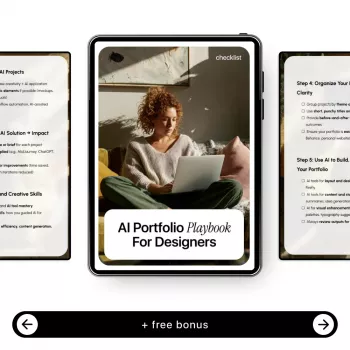
A portfolio of AI-powered design work should show more than polished images. It should help you explain the challenge, the choices you made, and how the finished work serves its audience. Our AI Portfolio Playbook for Designers offers an actionable checklist for moving from project selection to a presentation you can confidently share.
Start with a portfolio goal
Before choosing a layout or rewriting case studies, decide who you want to reach. Are you looking for a brand design role, freelance illustration clients, or opportunities to develop product concepts? Your answer can guide which projects lead the portfolio and which details deserve the most space.
Select work that demonstrates the skills those people need to see. A small group of relevant, well-explained projects can be more useful than a long collection of AI experiments. Look for variety in the problems you solved, while keeping a clear connection to the kind of work you want next.
Our playbook organizes the process into three practical stages: build your case studies, polish the presentation, and showcase the work to the right audience. You can use that structure whether you are creating a portfolio from scratch or revising an existing one.
Build case studies around design decisions
Give each project enough context for someone unfamiliar with the assignment to understand it. Start with the brief: who the work was for, what challenge you addressed, and what constraints shaped the outcome. A concept project can be valuable too; simply identify it as self-directed rather than implying it was commissioned.
Next, explain your process. If you used AI to explore visual directions, generate initial material, or support production, say so accurately. Then describe your own contributions, such as selecting a direction, revising compositions, building a visual system, or adapting the result to the brief. The goal is not to document every prompt or iteration, but to make the reasoning behind the work visible.
Choose a few stages that show meaningful development from early concept to final result. Include only sketches, outputs, client materials, and other assets you have permission to share. If a project is confidential, consider describing your role without revealing protected details, or leave it out until you have approval.
AI portfolio case study checklist
| Element | What to include | Purpose |
|---|---|---|
| Project brief | Audience, challenge, and constraints | Give the work context |
| Process | Selected iterations and AI-assisted steps | Show how the concept developed |
| Designer contribution | Decisions, edits, and refinements | Make authorship clear |
| Final outcome | Finished work and any verified results | Show the solution |
For example, a product campaign concept might show an initial visual direction, the composition you refined, and the final application. Explain why you made the changes rather than simply labeling each image as a step. If there are no measurable results, the finished design and your rationale can still demonstrate your skills.
Polish for clarity and trust
Once the case studies are assembled, edit them with a reviewer’s time in mind. Use short paragraphs, specific headings, and consistent labels. Remove repeated explanations and make sure each visual supports the story. A consistent layout can make separate projects feel cohesive without making every case study identical.
Review accessibility as part of the design process. Use legible text, sufficient contrast, and descriptive alternative text for meaningful images. Check that navigation works with a keyboard and that text remains readable when enlarged. The W3C Web Accessibility Tutorials provide practical guidance for these checks.
Be equally careful with disclosure and rights. Identify AI-assisted steps without overstating what a tool or you contributed, and respect any client confidentiality obligations. Confirm that you have the necessary permissions to publish materials and use the outputs shown. For background on copyright questions involving AI, consult the U.S. Copyright Office.
Finally, distinguish verified outcomes from intentions. If you cannot substantiate a claim about sales, engagement, or performance, leave it out or describe the project’s intended goal instead.
Showcase the portfolio with purpose
Lead with the strongest project for your intended audience. Make it easy to move between projects and back to the main collection, and use clear project titles so visitors know what they are opening. Your introduction can be brief: state what you design, identify relevant skills, and offer a straightforward way to contact you.
Test the portfolio on a phone, a tablet, and a larger screen. Check that images load, text is comfortable to read, and contact details are easy to find. Revisit the selection as your skills evolve; replacing an outdated project can be more effective than continually adding new ones.
If you want to practice presenting a product-focused concept, choose a subject that fits your goals and clearly label self-directed work. For example, our Stone Series Chandelier could serve as a starting point for a lighting campaign concept. Create or use only assets you have permission to publish, and do not present an independent concept as a commissioned campaign.
Put the playbook to work
Set aside time to review one project using the checklist above. Identify its audience, write a concise brief, select the most revealing process stages, and explain the decisions that led to the final work. Then review accessibility, disclosure, and permissions before sharing it.
For a checklist to guide your build, polish, and showcase process, explore our in-stock AI Portfolio Playbook for Designers, listed at $3.99 USD.
FAQ
Should designers disclose AI use in a portfolio?
Yes. Clearly describe the AI-assisted steps and your own contributions, while respecting client confidentiality and any publishing restrictions.
What should an AI-powered design case study include?
Include the brief, audience, constraints, process, AI involvement, your design decisions, and the final work. Add outcomes only when you can verify them.
How can designers make an AI portfolio easier to review?
Choose relevant projects, provide clear navigation and concise explanations, and make the presentation accessible. Include a visible way for visitors to contact you.














Leave a comment